
 Hugh Massie
Even reasonable decisions can lead somewhere you never intended to go. Asking the right questions can help you change course.
Every major dispute starts with a decision that looks obviously right: pursue the claim, defend the position, protect the business. What almost never gets flagged at that moment is that it is not really one decision. It is the first link in a chain.
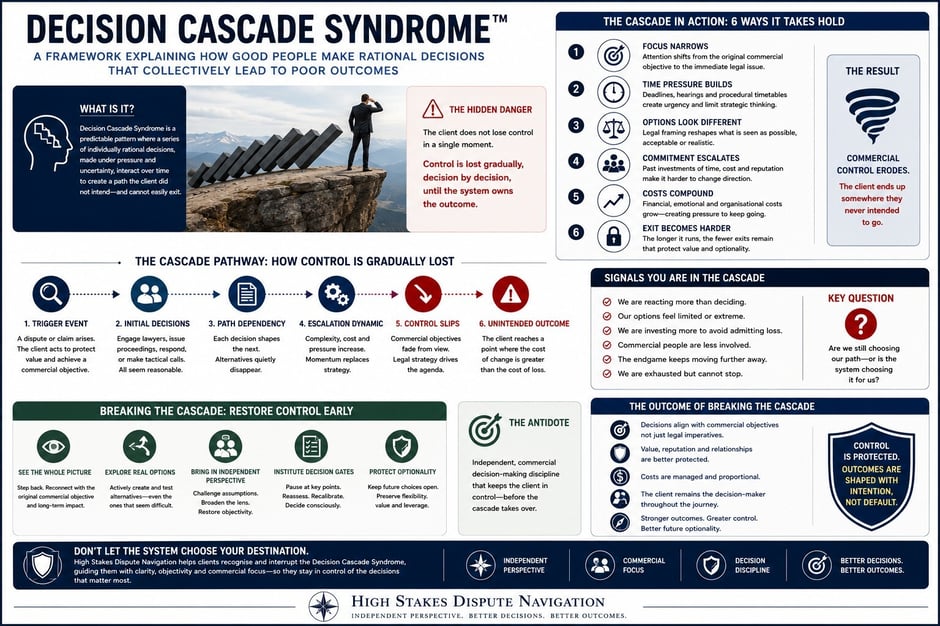
We call that chain Decision Cascade Syndrome — a sequence of individually reasonable litigation decisions that, left unmanaged, compounds into a downward spiral of cost, time, and lost commercial control. It is the single biggest reason a company can win a case and still lose the outcome it set out to protect.
This is the lens High-Stakes Dispute Navigation (HSDN) applies to every high-stakes dispute: not “is this decision reasonable,” but “what does this decision look like as the fortieth link in a chain.”
How the Spiral Runs
Decision Cascade Syndrome follows a recognizable path. A legitimate grievance produces a rational first decision. Lawyers, courts, opponents, and procedures take over the process. Applications, discovery, experts, hearings, and deadlines start to drive the journey. Costs escalate, and timelines drift as funding and governance come under strain. Commercial objectives fade from view as the cascade sets in. And the client risks losing control long before judgment is ever delivered.
Each step along that path is individually defensible: seek documents, amend pleadings, respond to an application, brief experts, resist delay, fund the next phase, change counsel, prepare for hearing, keep going. No single one of these choices looks like the moment control was lost. That is precisely the design flaw.
Decision Cascade Syndrome is not one bad call — it is a long sequence of individually sound ones, compounding.
Over time, the cumulative effect can be severe. Costs escalate. Timelines stretch. Key people move on or are removed from the process. Funders become strained. Directors and shareholders lose alignment and governance fractures. The original commercial objective becomes harder to see. The dispute starts to run the business, rather than the business running the dispute.
The real danger is not losing the case. It is losing control before the matter ever reaches judgment.
This is a structural problem, not a failure of any individual lawyer. Many lawyers are technically excellent and deeply committed to their clients. But the legal system has its own language, incentives, procedures, and momentum, and it is not built to manage the commercial, economic, and governance consequences of a dispute over time. That work falls to the client — at precisely the point the client has the least visibility into what is actually happening.
How High-Stakes Dispute Navigation Stops It
High-Stakes Dispute Navigation exists for exactly this problem.
It does not replace legal advice. It does not tell lawyers how to practice law. It creates a parallel commercial control room — the Decision Room — where the legal, economic, and commercial realities of a dispute are managed together, instead of the first crowding out the other two. Each discipline below is built to interrupt Decision Cascade Syndrome at the exact point where the next “reasonable” decision would otherwise become just another link in the chain.
-
The full journey is mapped up front — cost and timeline ranges across base, stress, and worst case — so the client knows what it is entering rather than discovering the shape of the commitment one step at a time.
-
Decision gates are installed at defined points, so continuing, recalibrating, negotiating, or stopping is a conscious choice, not a default of momentum. Key to this process is steadfastly defining and adhering to a high governance standard that protects all stakeholders.
-
The commercial narrative is protected, so the original story does not fragment across years of pleadings, affidavits, expert reports, and counsel changes.
-
Legal progress is translated into commercial consequence, so a procedural application, an expert report, or a change of counsel is read for what it means to cost, timing, leverage, and risk — not just to the case.
-
Governance is kept visible, so the client can see whether the board, funders, and key witnesses remain aligned as pressure mounts, rather than assuming alignment holds by default.
-
Opponent strategy is assessed commercially, not just legally, because some opponents litigate to win on the merits and others litigate to exhaust, delay, or destabilize.
-
Decisions are tested under pressure, to counter the sunk-cost bias, anchoring, fatigue, and desire for vindication that years of litigation quietly build into every choice.
High-stakes disputes can be necessary, and sometimes unavoidable — HSDN is not an argument against pursuing a claim or mounting a defense. It is an argument against doing either blind to the cascade.
In practice, that means asking a different set of questions at every major step, not just “Can we win?”
-
What will this cost in the base case, stress case, and worst case — and what happens if the matter takes three, five, or seven years?
-
What decision gates exist before more capital is committed?
-
Who is accountable for translating legal progress into commercial consequence?
-
What happens if the company wins legally but loses commercially?
These questions do not replace legal advice. They are what stands between a client running the dispute and a dispute running the client.
This is where the work of Arthur Psaltis and mine come together. We are both qualified chartered accountants who have worked at the intersection of capital, commercial judgment and high-stakes decisions, and we both have seen major disputes impose catastrophic consequences on stakeholders once Decision Cascade Syndrome is left to run unmanaged.
Mapped, governed, and reviewed from the outset, a dispute stays what it started as: one decision the client makes deliberately, and then another, and then another — rather than a chain the client can no longer see the end of.
The client must remain the decision-maker. The lawyers should run the legal case.
Book a Call with one of our experts to learn more!