
 Hugh Massie
1 min read
The Dispute Machine™: How Clients Lose Control Inside the Legal Process
 Hugh Massie : September 09, 2026
What starts as a business decision can become a process driven by legal momentum. Learn how to stay in the decision room.
Disputes can take control of your choices before you realize it, unless you have a structured environment to keep you in the driver’s seat.
A company can enter a major dispute, confident that it is in control — a legitimate grievance, sound legal advice, an engaged board, a budget it believes is manageable. But major disputes rarely stay contained. They move into a system the client does not run: the court's timetable, the opponent's tactics, the funder's expectations, and a legal process with its own language and momentum.
We call that system the Dispute Machine. And the way it quietly takes hold has a name: Decision Cascade Syndrome — the process by which a long chain of individually reasonable litigation decisions (seek documents, brief experts, resist delay, fund the next phase, change counsel) compounds, unmanaged, into a multi-year commitment of capital, time and attention that no one explicitly chose.
The client may still believe it owns the dispute. In practice, the legal process, the opponent, the court timetable, the funder, the experts, and procedural pressure can begin making the most important decisions by default. That is where commercial control erodes
High-Stakes Dispute Navigation (HSDN) exists to prevent that disconnect.
It does not replace legal advice. It does not tell lawyers how to practice law.
It creates a parallel commercial control room for the people whose capital, business, reputation, and future are actually at stake.
We call that the Decision Room.
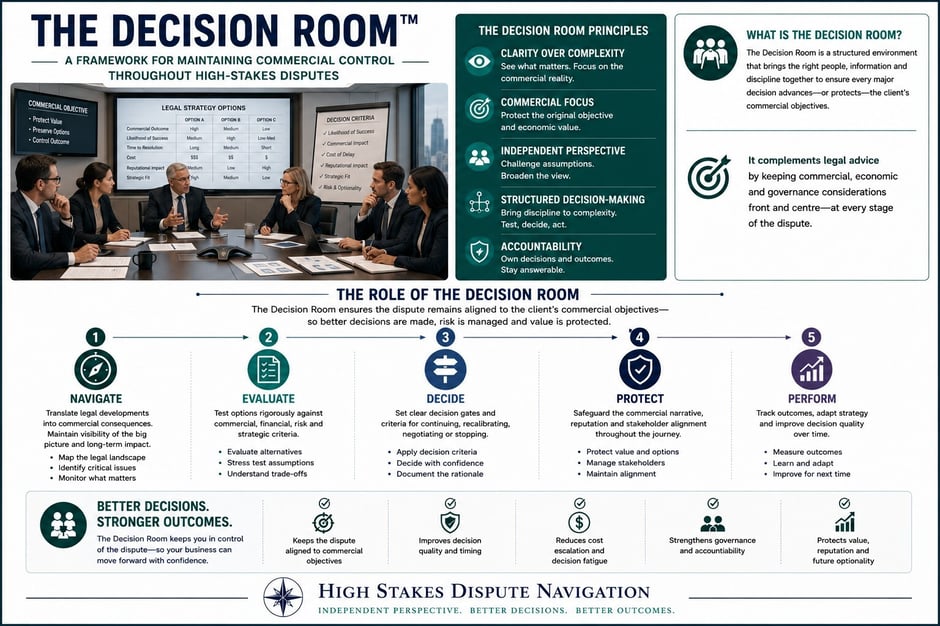
It is where three realities are brought back together. The legal reality asks what the case is, what must be proved, and what the prospects are. The economic reality asks what this is costing, what capital is trapped, and how long the organization can sustain the pressure. The commercial reality asks what actually happened, what the original objective was, and whether the dispute strategy still serves it.
Most disputes are managed heavily through the first reality. The other two are often under-managed. That is where Decision Cascade Syndrome takes root — and where the risk sits. HSDN gives boards, owners, executives, investors, and stakeholders a structured framework for managing all three realities at once, starting with a diagnostic.
Before a client commits further capital, changes strategy, files lay affidavits, issues or defends subpoenas, engages experts, enters mediation, briefs new counsel, or proceeds toward trial, the matter is assessed against the risks that most often drive control erosion. The picture can change monthly, sometimes weekly — which is exactly why it needs transparency and structure rather than momentum.
The purpose is not to produce another legal opinion. The purpose is to answer a different question: Is the client still in control of the dispute?
The framework we are launching is built from lived experience of what happens when Decision Cascade Syndrome is left unmanaged. It targets the risks that most often sit outside the legal brief but determine the commercial outcome:
Cost Escalation without a full scenario model
Timeline Drift that outlasts the commercial cycle of the business
Opponent Tactics that use delay, complexity, or expert volume as economic pressure
Governance Strain between boards, shareholders, funders, and management
Loss of Continuity when advisers, counsel, judges, or key witnesses change
Commercial Narrative Fragmentation as facts are filtered through pleadings, affidavits, experts, and hearings
Decision Fatigue as years of pressure distort judgment
The Gradual Transfer of Practical Control from the client to the process
These risks are rarely dramatic at the beginning. They compound quietly — that is Decision Cascade Syndrome in practice. By the time they are obvious, options may already have narrowed or vanished.
That is why the first task in any major dispute is not simply to ask “Can we win?” It is to ask a harder set of questions:
What will this cost in the base case, stress case, and worst case?
What happens if the matter takes three, five, or seven years?
What capital will be trapped?
What will this do to valuation, funding, operations, and management focus?
What decision gates exist before more money is committed?
Who owns the commercial narrative?
Who is accountable for translating legal progress into commercial consequences?
What happens if the opponent uses the process itself as pressure?
What happens if the company wins legally but loses commercially?
These questions do not replace legal advice. They protect the client from mistaking legal activity for commercial control — which is the difference between running a dispute and being run by one.
That is the role of the Decision Room. It is not a second legal team. It is not a parallel argument about the merits. It is a structured environment in which the client sees the full dispute journey before the next major decision is made — and interrupts the cascade before it makes the decision for them.
Not just the next legal step, but the full commercial pathway: cost and timeline ranges across base, stress,s and worst case; funding requirement; management burden; likely pressure points; settlement windows; decision gates. The client should never commit capital to a dispute without knowing what journey it is actually entering.
A major dispute should not proceed on momentum. At defined points, the client must consciously decide whether to continue, recalibrate, negotiate, or stop. Without decision gates, the legal process becomes the strategy — and Decision Cascade Syndrome sets in by default.
In long disputes, the original story fragments across emails, affidavits, expert reports, pleadings, and witness statements as people leave, counsel changes, and memory decays. The Decision Room maintains a living commercial narrative: what happened, who knew what, why decisions were made, and how the legal case connects back to the commercial reality.
A procedural application may be a delay tactic. An expert report may be an economic weapon. A discovery exercise may be a major capital allocation decision. A change of senior counsel may be a moment to reassess. The Decision Room asks what each legal development means for cost, timing, leverage, risk, funding, governance, and commercial objective.
High-stakes disputes place sustained pressure on boards, shareholders, funders, executives and key witnesses, and alignment at the start does not guarantee alignment two years later. The Decision Room monitors whether the decision-making structure is still intact, whether the right people remain involved, and whether funding pressure is starting to distort judgment.
Some opponents litigate to win on merits. Others litigate to exhaust, delay, or destabilize. HSDN helps identify when procedural behavior is being used as economic pressure, so the client does not respond to every move on the opponent's terms.
Litigation distorts decision-making. Sunk costs create bias. Strong early advice creates anchoring. Delay creates fatigue. Fear of loss creates overreaction. The Decision Room slows those moments down and brings the decision back to evidence, economics, risk tolerance, and strategic purpose — the direct antidote to Decision Cascade Syndrome.
This is where my work with Arthur Psaltis comes together. We are both qualified chartered accountants who have worked at the intersection of capital, commercial judgment, and high-stakes decisions, and have both seen major disputes impose catastrophic consequences on stakeholders when commercial and economic risk are not managed alongside the legal process.
The objective is not to add another adviser into the chain. It is to give the client back a system of control.
High-Stakes Dispute Navigation is built around clear phases:
Initial risk diagnostic
Full dispute-control assessment
Scenario modelling and decision-gate design
Living commercial narrative development
Monthly dispute-navigation review
Decision Room sessions at major inflection points
Settlement, funding, counsel-transition, and trial-readiness reviews where required
Each phase answers the same central question: What must the client know, decide, and control before the next step is taken?
High-stakes disputes can be necessary. Sometimes they are unavoidable — a company must pursue a claim or defend itself because the commercial consequence of doing nothing is unacceptable. But if the matter is not mapped, modelled, and governed from the outset, the Dispute Machine can take over, and Decision Cascade Syndrome can quietly decide the outcome instead of the client.
The result can be catastrophic: personal lives immeasurably impacted, capital consumed, value impaired, transactions disrupted, governance fractured, stakeholders exhausted, and the original commercial purpose lost inside the machinery of the process.
HSDN was created to help clients avoid that outcome — not by telling lawyers how to practice law or giving legal advice, but by helping the people whose capital, business, and future are at stake remain in control of the decisions that determine the real outcome.
The Dispute Machine pulls clients into the process, one reasonable-looking step at a time.
The Decision Room breaks that cascade and brings them back to controlling the decision.
That is the difference.
A high-stakes dispute may still be difficult, expensive, and demanding of excellent legal advice and sustained commitment. But it should never become open-ended, opaque, and disconnected from the people whose interests it is meant to serve.
The client must remain the decision-maker. The lawyers should run the legal case.
Book a Call with one of our experts to learn more!
1 min read
Hugh Massie : September 09, 2026
What starts as a business decision can become a process driven by legal momentum. Learn how to stay in the decision room.

1 min read
Hugh Massie : September 01, 2026
The biggest risk in a dispute may be how your own decisions evolve. A structured process can help you pause, reassess, and stay in control.

1 min read
Hugh Massie : February 04, 2023
Money Energy Law #4: Find happiness in your life. Positive outcomes will provide tranquility, joy, and a longer life.