
 Hugh Massie
1 min read
The Pervasive Influence of the CEO
 Hugh Massie : September 24, 2024
Our research of S&P 500 execs shows how a CEO’s financial behavior impacts the entire organization…and which traits can dramatically affect the...

Due diligence should start with identifying the behavioral traits of the founder.
Startups are engines of innovation and economic transformation, and their potential can be extremely attractive to investors. But it doesn’t take a lot of research to uncover the fact that most fail early on, despite early positive indicators.
Studies continue to suggest that 75- 90% of startups fail.
So, investors have to dig deeper than the financials, market positioning, and business model as they carry out their due diligence. Often, the most critical factor is the natural behavioral style of the founder and those of the supporting leadership team. Let’s look at some stats.
According to Startups.com and various studies, the top reasons startups fail are:
No Market Need (42%)
Running Out of Cash (29%)
Not the Right Team (23%) – Including Leadership and Culture Failures
Competition (19%)
Product and Business Model Failures (17%)
Timing (13%)
Here’s the good news. If nearly a quarter of failures are people-related, we can help you predict which teams are best equipped to help get the business off the ground, scale it over time, and keep it running long into the future. So, you can take that risk factor out of the equation.
Entrepreneurs are typically charismatic and brimming with excitement about their products and ideas. That’s important in the early stages of business development, but less so as a business grows. So, you need to know what else might be a natural part of their behavioral makeup that will keep things going at full speed.
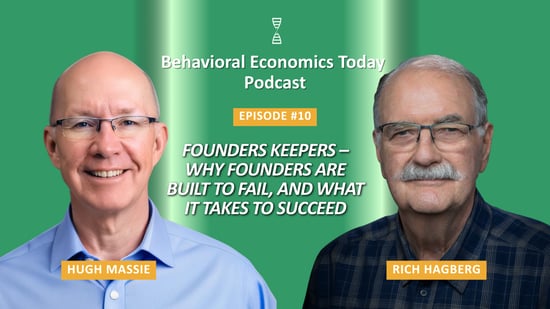
DNA Behavior’s founder, Hugh Massie, discussed this topic with Rich Hagberg, co-author of Founders Keepers. They agreed that it’s not the age or background of the individual that is key, but rather who they are.
When it comes to identifying successful founders, personality is more important than biography.
The research in Hagberg and Tzuo's book highlights the need for founder-led companies to have the following three leadership capabilities:
Here’s how they map to the DNA Behavior model of behavioral styles:
Leadership Capabilities Mapped to Behavioral Style
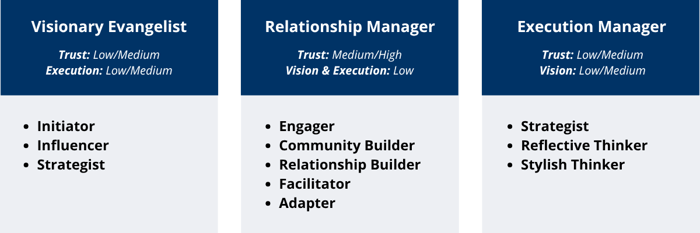
The issue is that no person is strong in all three of these capabilities. So, a business needs to have co-founders, partners, or key executives in place who can round out the leadership team from a behavioral perspective.
Founders Keepers does a great job of explaining the predictable failure points for founder-led companies and how they must work on themselves to unleash performance. It requires self-awareness, adaptability, and trust in every team member.
Here’s what to be conscious of:
It’s the founder’s responsibility to create value for the shareholders, so you want to know which behavioral traits will make them most likely to succeed. The research we conducted in 2017, based on 500 founders who had built businesses to annual revenue over $1 million, paints a solid picture.
We found that the most important behavioral traits of founders are:
Top Traits of Successful Founders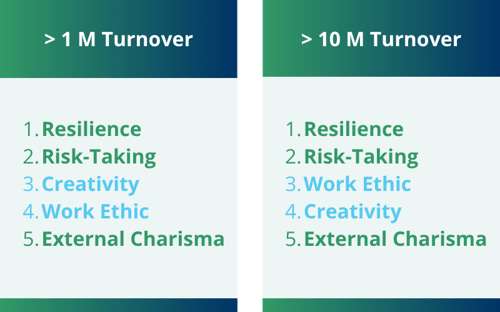
*Notice that, as the business grows, Work Ethic becomes more important than Creativity.
In general, the DNA Behavior Initiator style will be the most common for successful founders, since they typically have strengths in the first four traits above. Strategists and Influencer styles are also common among founders. In any case:
A well-balanced leadership team is essential because no founder has all the traits to succeed on their own.
Learn more about the core behavioral traits of successful founders: Mastering Entrepreneurial Talents
Over the last two decades, we have learned that there are some very specific things you need to know about a founder before committing to an investment. The behavioral insights uncovered by our psychometric assessments provide some of those answers. You can use them as a guide for in-person follow-up.
You need to know:
As you undergo your due diligence process, remember that the human factor is just as vital as financial metrics and product validation. Authority bias, a lack of psychological safety, and founder transition issues are often at the root of startup failures.
So, in your analysis, consider utilizing the DNA Behavior web app. Founder and team assessments will tell you what you need to know about their natural talents and financial behavior styles.
You can test:
Startup failure is not random. It reflects market misalignment, financial errors, and especially founder psychology and culture. We can help you understand the people behind those promising ventures, so you can make informed and profitable decisions.
Book a Call with one of our experts!

1 min read
Hugh Massie : September 24, 2024
Our research of S&P 500 execs shows how a CEO’s financial behavior impacts the entire organization…and which traits can dramatically affect the...

1 min read
Hugh Massie : September 07, 2023
Do you want a way to differentiate your advisory practice and improve investor success across the board?

1 min read
Hugh Massie : June 10, 2024
If your work takes too much out of you each day, it doesn’t mean your career is about to hit a dead end. It’s just a clue that a change of direction...