In a high-stakes dispute, understanding where a decision could lead is just as critical as the decision itself.
Ask most clients in a major dispute what happens next, and they can tell you. Ask them what happens after that — and after that — and the answers get thinner fast. Not because the lawyers are withholding anything, but because no one has ever laid out the whole journey in one place. The client is being answered one question at a time, in a matter that will ask hundreds of questions before it is over.
That is not a legal failing. Legal advice is built to answer the question in front of it — the next application, the next deadline, the next piece of evidence — accurately and well. It was never built to show the client the full shape of the decision they are actually in.
That is what a Decision Map™ is for.
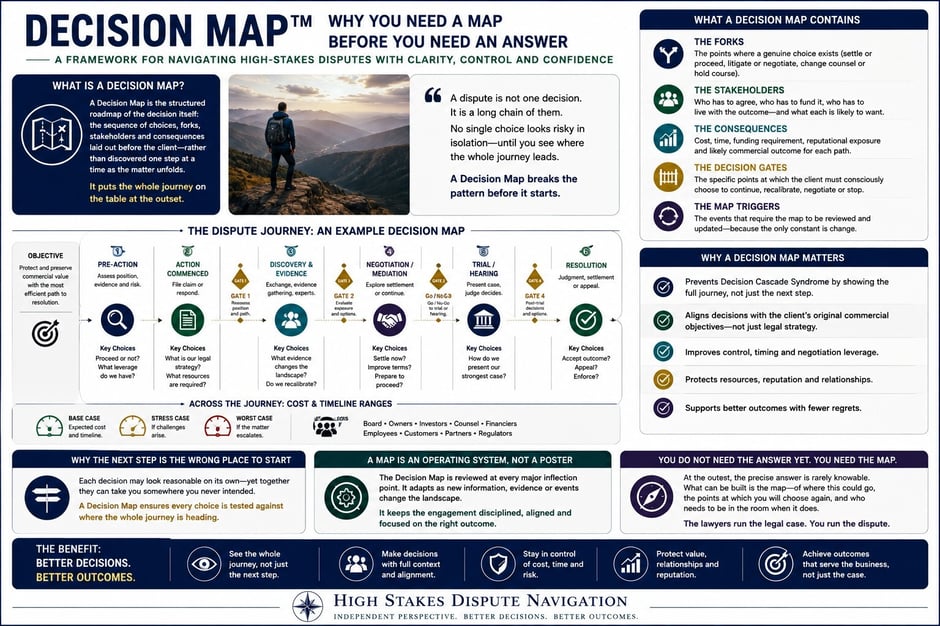
A Decision Map is the structured roadmap of the decision itself: the sequence of choices, forks, stakeholders, and consequences laid out before the client, rather than discovered one step at a time as the matter unfolds.
Why the Next Step Is the Wrong Place to Start
A dispute is not one decision. It is a long chain of them — seek documents, respond to an application, brief experts, consider a mediation offer, change counsel, decide whether to appeal. Taken one at a time, each choice can be made competently and still leave the client somewhere it never intended to go, because no single choice was ever tested against where the whole journey was heading.
That is the same mechanism behind Decision Cascade Syndrome: a client discovering the shape of its commitment one reasonable-looking step at a time, instead of seeing it up front. A Decision Map exists to break that pattern before it starts, by putting the terrain on the table at the outset — cost and timeline ranges across the base, stress, and worst case; the decision gates between now and resolution; the stakeholders whose incentives and behavior will shape each fork; and the consequences, financial and commercial, that follow from each path.
What a Decision Map Actually Contains
A useful map does more than list the procedural steps. It shows:
-
The Forks — the points where a genuine choice exists (settle or proceed, litigate or negotiate, change counsel or hold course), not just the procedural steps that follow automatically from the last one
-
The Stakeholders at Each Fork — who has to agree, who has to fund it, who has to live with the outcome, and what each of them is likely to want
-
The Consequences of Each Path — cost, time, funding requirement, reputational exposure, and likely commercial outcome, not just legal prospects
-
The Decision Gates — the specific points at which the client must consciously choose to continue, recalibrate, negotiate, or stop, rather than proceeding on momentum
-
The Triggers for Redrawing the Map — a change in the evidence, an opponent's move, a shift in funding, a new judge or counsel — because a map drawn once at the start and never revisited becomes fiction within months
None of this replaces legal advice. The lawyers still own the legal strategy and the next procedural step. The Decision Map sits alongside that advice and answers a different question: given where this could go, is the next step still the right one — for the business, not just the case?
A Map Is an Operating System, Not a Poster
The value of a Decision Map is not the diagram itself. It is what the diagram is used for: it is the operating system that keeps a Decision Room engagement disciplined and sequenced from the first diagnostic to the final resolution, reviewed at every major inflection point rather than filed away after the first meeting.
Consider a real fork most clients face at some point: whether to accept a mediation offer that resolves the matter for less than the client believes it is worth. Without a map, that decision gets made in isolation — against the emotion of the moment, the sunk cost already spent, and whatever the lawyers' immediate read happens to be.
With a map, the same decision gets made against the full picture already laid out: what the stress and worst cases look like if the client proceeds, what the funding runway actually supports, who among the stakeholders needs to be aligned before saying yes or no, and what the client's own original commercial objective was before the dispute began.
The map does not make the decision easier. It makes the decision honest — measured against the whole journey, not just the pressure of the moment.
You Do Not Need the Answer Yet. You Need the Map.
Clients entering a high-stakes dispute almost always want the answer first: Will we win? What will it cost? How long will it take? Those are fair questions, and often unanswerable with precision at the outset. What can be built at the outset is the map — the range of where this could go, the points at which the client will get to choose again, and who needs to be in the room when it does.
The lawyers should run the legal case. The client must run the dispute from the commercial realities.
A Decision Map is how the client does that — by seeing the whole journey before committing to the next mile of it.
Book a Call with one of our experts to learn more!

 Hugh Massie
 Hugh Massie : September 09, 2026