
 Hugh Massie
Revolutionizing the Way We Meet
 Hugh Massie : July 10, 2023
Having access to behavior science insights can mean more productive collaboration and positive meeting outcomes. It's the new way to meet!

Human Lifetime Economic Value is the new measure of wealth, so advisors need to know how to manage the behaviors that drive it.
The wealth management industry is entering a profound transformation.
For decades, success was defined by a single metric: Assets Under Management (AUM). Firms competed to gather assets, scale portfolios, and optimize returns.
That model is now breaking down.
Global AUM is projected to grow significantly over the next decade, yet profitability per dollar managed is declining due to fee compression, rising costs, and increasing client expectations.
This creates a paradox:
Growth is increasing, but value creation is not.
The implication is clear. The industry is not just evolving—it is redefining how value is measured.
We are moving from an AUM-based model to something far more powerful: Human Lifetime Economic Value (HLEV).
AUM measures what a client has today.
HLEV measures what a client will become over time.
It reflects the total economic value a client can generate across their lifetime, influenced by:
This shift is fundamental.
It moves wealth management from:
And importantly, it aligns perfectly with two major forces reshaping the industry:
Over the past decade, AI has transformed wealth management by automating the “Quanta”:
These capabilities improved efficiency and scale, but they didn’t solve the real problem.
Wealth management is not fundamentally a math problem. It is a human decision-making problem.
Clients don’t fail financially because portfolios are poorly optimized.
They fail because they:
And most firms still try to understand these behaviors using:
This data only captures a fraction of reality.
This is where the real transformation begins.
Behavioral data is liquid gold.
It is the most underutilized strategic asset in wealth management today.
Because behavioral data doesn’t just describe clients—it explains:
In fact:
Behavioral data ultimately determines a client’s lifetime economic value—not just their current assets.
Traditional data shows only what’s visible:
But beneath the surface lies what actually drives outcomes:
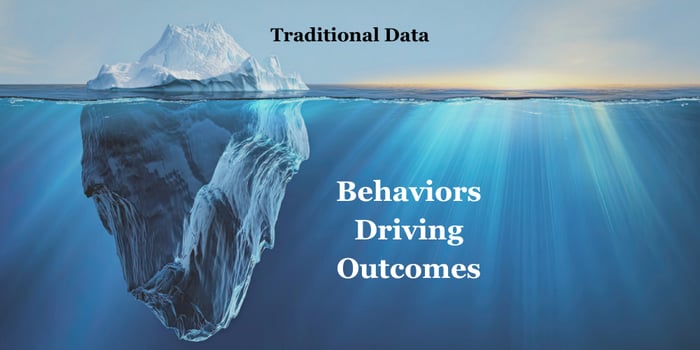
This “invisible 90%” is where real value is created—or destroyed.
AI, when combined with behavioral science, allows firms to finally quantify the behavioral layer driving outcomes—and use it systematically.
Artificial intelligence becomes exponentially more powerful when fueled by behavioral data.
Instead of optimizing for averages, AI can now:
For the first time, firms can begin to predict and actively grow a client’s Human Lifetime Economic Value.
This is the true breakthrough.
Historically, personalization was limited to top-tier clients. Now:
Behavioral AI enables personalization at scale.
AI can continuously analyze:
This allows advisors to intervene:
The result is a shift from segmentation to “segment-of-one” personalization.
And this is critical:
Personalization is no longer about better service. It is about shaping long-term economic outcomes.
As AI absorbs analytical work, the advisor’s role evolves.
The future advisor is not defined by:
But by connection intelligence, which allows them to:
This leads to a powerful shift:
The advisor of the future will not be measured by Assets Under Management, but by the Human Lifetime Economic Value they help create.
Behavioral AI is not just a conceptual shift—it delivers measurable results.
Firms are seeing:
These gains reflect something deeper:
Profitability is no longer driven by asset accumulation. It is driven by improving lifetime client outcomes.
Several structural forces are accelerating this shift:
Firms are no longer competing on products or portfolios.
They are competing on:
And ultimately:
The industry is undergoing a fundamental evolution:
Assets Under Management → Behavior Under Management → Human Lifetime Economic Value
This is not just a new metric. It is a new operating model.
It reframes:
AUM is a snapshot.
Human Lifetime Economic Value is the story.
The firms that win in the next decade will not be those that manage the most assets.
They will be the firms that best understand how humans behave with money—and how to help them make better decisions over a lifetime.
And in that world, AI does not replace advisors.
It makes them unstoppable.
Book a Call with one of our experts, and we’ll show you how our AI-driven behavioral tools help drive HLEV!
 Hugh Massie : July 10, 2023
Having access to behavior science insights can mean more productive collaboration and positive meeting outcomes. It's the new way to meet!
 Hugh Massie : June 10, 2024
If your work takes too much out of you each day, it's a clue that a change of direction is needed...and behavioral science can help!
 Hugh Massie : March 18, 2024
Is your company future-proof? Let’s look at why 45% of CEOS are fearful about how their business will hold up over the next decade.