
 Hugh Massie
The Untapped Value of Behavioral Data
 Leon Morales : June 22, 2026
The new Behavioral Economics Today Podcast explores how behavioral data is becoming the liquid gold propelling businesses into the future!

There's a way that financial data can speak clearly to everyone, helping business owners spot warning signs, avoid complacency, and act early.
Ruth King and I have dedicated our careers to helping people make better financial decisions, approaching the challenge from different perspectives but arriving at a similar conclusion:
Numbers only matter if people can understand them — and act on what they see.
Ruth, founder of Financially Fit Business, has spent more than 40 years helping business owners better understand the financial health of their companies and visualize trends before problems arise. Her experience has shown her that many can look directly at a P&L or balance sheet without really understanding what the numbers are telling them.
As founder of DNA Behavior, I approach financial decision-making from a behavioral standpoint, and have found tremendous value in collaborating with Ruth over the years. People don’t all interpret the same information in the same way. Their natural behavioral tendencies influence what they notice, what they question, and how they respond.
Together, in this episode of the Behavioral Economics Today Podcast, we explore how financial data can be presented so everyone in the room can understand it, how behavioral differences influence financial decisions about the data, and why paying attention to the numbers before a crisis can make all the difference.
Business owners often see the numbers without understanding what they mean or what they should be looking for because they’re wrapped in a cumbersome report. That’s why Ruth developed a tool that turns financial data into impactful graphs that make trends, changes, and potential problems easier to see.
The goal isn’t simply to make financial reporting prettier to look at or easier to read. It’s to help people understand what the numbers are telling them and recognize when something needs attention.
“Once you start understanding numbers, you can take care of the issues before they become crises and build wealth. And that's the bottom line.”
- Ruth King
Helping business owners make sense of their financial numbers sits at the heart of the conversation, and is also what inspired Ruth to write The Courage to Be Profitable. That clarity can prevent what I refer to as the Decision Cascade Syndrome™.
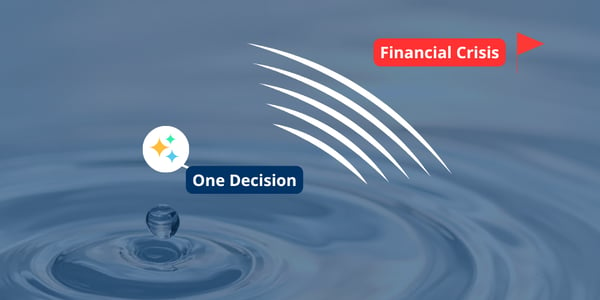
One decision
↓
Cash flow changes | Customer impact | Staffing impact
↓
Delayed payments | Lost revenue | Higher costs
↓
Margin pressure | Cash shortage | Reduced flexibility
↓
Financial crisis
Even when the financial data is clear, behavioral styles influence what people naturally notice, prioritize, and act on when reviewing the information. We discussed how different people can approach the same numbers and reach varying conclusions.
Two people can look at the same financial information and see very different things.
Here’s how some of those perspectives might show up:
None of these perspectives is inherently wrong. The risk comes when they aren’t brought together.
A team with different behavioral styles can make better financial decisions when people feel comfortable explaining what they see, questioning the numbers, and listening to perspectives that differ from their own.
Financial graphs can improve decision-making by giving people with different perspectives a common, easier-to-understand view of the business.
I once served on a nonprofit board where members were looking at the same financial statements but interpreting them from very different angles. Without a common visual framework, some people couldn’t see potential problems, while others assumed the accountants should handle the numbers.
Graphs can change that conversation. Instead of asking everyone to interpret a complicated financial statement, a team can look at the same trend and ask:
It’s a great way to create psychological safety, giving people a more comfortable environment to ask questions and raise concerns without feeling that they need to be the financial expert in the room.
The goal isn’t to eliminate behavioral differences. It’s to give those differences a shared foundation for a productive conversation.
Interpreting the numbers correctly isn’t the only challenge. Financial complacency can become a serious risk when leaders stop paying attention to warning signs simply because the business appears to be doing well.
Ruth compared financial review to driving. Something that initially requires intense concentration eventually becomes routine. Once it becomes routine, attention can drift. The same thing can happen when a business appears to be performing well. Leaders become comfortable, assume everything is fine, and stop looking closely at the numbers.
Ruth shared the example of a roughly $15 million company that was performing well until it stopped paying attention to the details. Supplier prices increased, rates weren’t always adjusted, and productivity declined without enough attention being paid to why. Eventually, gross margin approached overhead, and profits were nearly gone.
The warning signs were there, but no one noticed.
Once the company started paying attention again, performance improved. By creating a consistent process for reviewing financials, attention can become a habit rather than something that happens only when there’s a crisis.
Profitability matters more than revenue growth alone because a larger top line does not necessarily mean a healthier business. Ultimately, the bottom line is what drives long-term company value.
Business owners can become focused on growing revenue while losing sight of what the business actually keeps. Ruth emphasized the importance of understanding profit, cash, and the balance sheet rather than relying on revenue alone.
A growing business can still face financial pressure when growth requires more working capital, receivables continue to climb, or profitability isn’t keeping pace.
Understanding those relationships gives business owners a clearer picture of whether growth is actually making the business healthier.
Business owners can spot financial problems earlier by making the numbers easier to understand, considering how different people interpret them, and creating an environment where people feel comfortable asking questions.
Behavioral differences then become an advantage rather than a barrier:
The objective isn’t to make everyone see the numbers the same way. It’s to give everyone a clear enough view to ask the right questions and make better decisions. That can be the difference between noticing a warning sign early and waiting for a crisis to force action.
“Once you start understanding numbers, you can take care of the issues before they become crises and build wealth.”
-Ruth King
Watch the full episode of the Behavioral Economics Today Podcast to hear our insightful discussion about financial health, behavioral differences, financial visualization, psychological safety, and making better decisions before problems escalate.
Do you have a unique approach to bridging the gap between psychology and economics in your business?
Apply to be our next guest!

 Leon Morales : June 22, 2026
The new Behavioral Economics Today Podcast explores how behavioral data is becoming the liquid gold propelling businesses into the future!

 Hugh Massie : September 01, 2026
The biggest risk in a dispute may be how your own decisions evolve. A structured process can help you pause, reassess, and stay in control.

 Ryan Scott : April 14, 2025
With Digital Scan’s instant insights, behavioral intelligence is now available at warp speed! Let’s look at four game-changing use cases.