
 Hugh Massie
Investors Have a New Tool to Predict Future Profitability
 Hugh Massie : October 07, 2024
One of the most crucial factors in a company’s success is the financial behavior makeup of the executive team. We can provide that insight!

Stagnant client dashboards may be putting blinders on wealth advisors, obscuring the path to behavior-based personalization.
Client portals are getting slicker, the dashboards getting richer, and every CRM vendor now promises a real-time view of net worth, risk tolerance, and goal progress, all on one screen. The problem is, the more sophisticated the interface looks, the easier it is to mistake a partial picture for the full story.
An advisor I spoke with recently had just finished rolling out a beautiful new client dashboard. It had a brilliant display of live account values, a risk tolerance score updated quarterly, and a goals tracker showing green, amber, or red status for retirement, education funding, and legacy planning. It was genuinely impressive by any measure.
But three weeks after going live, a long-standing client of theirs liquidated a diversified portfolio into cash during a single volatile week, against every recommendation on record. His risk tolerance score, sitting quietly on the dashboard, said moderate.
That gap is worth thinking about, because I believe it is the most expensive misunderstanding in wealth management right now. A client dashboard is not a behavioral operating system. Firms buy the first, believe they have built the second, and then cannot explain why clients keep behaving like strangers.
The distinction is simple once you see it. The client dashboard and behavioral operating system have very different jobs, and only one of them lives on screen.
A dashboard shows you what a client said. A behavioral operating system anticipates what a client will do.
Most client decisions can be predicted with the right tools, but a dashboard alone isn’t enough. It requires something working beneath the surface, connecting enterprise data with a client’s real-time financial circumstances to reveal what they’re likely to do next.
Think about what actually goes wrong with clients. The panic-sell during a downturn from someone who scored moderate on a form eighteen months ago. The adult child who inherits and disengages because nobody adjusted the communication style to fit them. The long-time client who quietly moves assets because a life event changed everything about how they think, and nobody adjusted the conversation to match. Now ask honestly: would a dashboard have caught any of that? It would not, because:
A risk questionnaire is a snapshot, and behavior is not static.
Daniel Kahneman's research on investment decisions found up to 41% variability in how investors and professionals value the exact same numbers. If the same portfolio can generate wildly different reactions depending on who is looking at it and what state they are in, a single point-in-time score was never going to hold.
The software is not the problem. Good dashboards do exactly what they promise, and consolidated visibility is genuinely valuable. I would never argue that an advisor should not have one. The failure is in what firms conclude from having it.
Here is why the mistake is so easy to make. A full dashboard feels like knowing your client. When every number is visible, the anxiety that drove the purchase in the first place goes quiet. That relief is the reason the deeper work stops feeling urgent. The dashboard does not solve the problem of not truly knowing the client. It solves the feeling of not knowing, which is worse, because at least the feeling was telling you something true.
Below the surface of every dashboard sits the layer nobody sees, because it is not a screen. It is the “behavioral operating system” invisibly at work, and it looks like this:
→ Decisioning intelligence. Not what a client said about risk eighteen months ago, but how they actually behave under stress, updated continuously as life and markets move, not once at onboarding.
→ Communication calibration. The right message, in the right tone, at the right cadence for that specific person, generated automatically rather than left to whichever advisor happens to pick up the file.
→ Behavioral memory. What this client's natural style is, what triggers a poor decision, and what has already been tried, carried forward even when the advisor changes.
→ Continuous signal. A market move or a life event read through the lens of how this specific person responds to stress, not a generic quarterly newsletter sent to everyone at once.
None of that is displayed anywhere on a CRM. It is behavior.
In a business built entirely on trust and decisions made under emotion, behavior is what the client relationship actually is about.
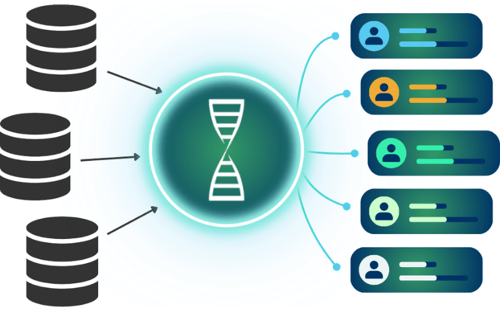
This is the deeper premise behind HelixBOS at DNA Behavior. It’s a behavioral operating system that runs beneath the CRM the advisor already uses, powered by what we call “Decisioning Digital Twins”, which are living behavioral profiles of every client. The Decisioning Digital Twins are initially built based on over 4,000 “hard-wired” talent and financial behavior insights, which have 97.1% accuracy and inherently stay current as circumstances change. Then, as new financial and life information comes to hand and decision preferences become clearer, the Decisioning Digital Twin is dynamically updated.
With this approach, the over 4,000 behavior and money insights work continuously rather than sitting idle in a PDF from the onboarding meeting. The dashboard becomes what it was always meant to be: a window onto a system that is already working, not the system itself.
The test I would suggest is short. Look at your own client experience and ask a simple question.
If your CRM went dark tomorrow, would you still know how each client behaves under stress, how they want to be communicated with, and what to do next before they call you?
If the answer is yes, you are likely to have a behavioral operating system, and the dashboard is a helpful window onto it. If the answer is no, that is worth knowing now, before the next downturn tells you the hard way.
Firms winning the personalization race are not the ones with the most beautiful dashboard. They are the ones who built the behavioral intelligence first, and let the screen reflect a system that already understood the client.
Structure using behavior first. Then the screen.

If you have questions or would like to discuss the details with an executive on our team, please Contact Us.
 Hugh Massie : October 07, 2024
One of the most crucial factors in a company’s success is the financial behavior makeup of the executive team. We can provide that insight!
 Hugh Massie : March 25, 2026
Due diligence should start with identifying the behavioral traits of the founder!
 Hugh Massie : April 21, 2025
If you think winning is all about strategy, product mix, or market timing, you’re only seeing half the picture!