We’ve prepared a behavioral cheat sheet, collected from the works of DNA Behavior’s executive chairman, Hugh Massie!
When Hugh Massie founded DNA Behavior in 2001, his goal was to uncover how hard-wired patterns of behavior impacted decision-making. We now know that a person’s “public self” can look functional, agreeable, even confident—but when money, stakes, or relationships cause pressure, an instinctive behavioral pattern appears.
“Pressure reveals hardwired behaviors. You don’t rise to the occasion; you revert to your instincts.”
Our traditional psychometric assessments and AI-driven Digital Scan technology reveal these hidden influences. And Hugh spends a large part of his time educating people about how this behavioral intelligence can be used to build stronger, more profitable businesses. He is a prolific writer and podcaster, and we maintain a large library of these educational materials.
Educational Resources
Here’s your behavioral cheat sheet, collated from Hugh’s vast collection.
Challenge Your Own Business Model
The business-as-usual mindset, even amid success, can hold you back more than you think. You should periodically challenge your own business model.
“Reset the goal, challenge the existing model, and explore new possibilities to break linear constraints.”
By adopting an exponential mindset, you may find ways to multiply performance, starting with the behavioral element. That mindset shift at the top will flow down into spending, governance, investment in people, perks, training—ultimately shaping both culture and results.
Create a Behavioral Heat Map
To enable a fast diagnosis of capability gaps, you have to create a behavioral heat map. Take a look at the natural behaviors of your leadership team and everyone else in the organization, including clients and other stakeholders. This will help you identify potential issues and pinpoint where your business is being limited.
“If we can predict the default behavior under stress, we can improve decision-making, leadership, and client outcomes.”
You may find that client service behavior is the underlying reason for a drop in sales. Or it could be that your own behavioral style needs some adapting in order to communicate more effectively with your team.
Revitalize the Burnout Club
Burnout in high-stakes, high-pressure roles isn’t inevitable or unfixable. The key is to look at how a person got there and take steps to readjust.
“Burnout is often misalignment plus pressure—wrong role, wrong culture, no psychological safety.”
It’s all too easy to destroy people with the wrong role or company culture, which, in turn, can destroy the business. So, even though shareholders expect money, people have to come before the numbers.
“Numbers are lag indicators, whereas behavior is upstream and more predictive.”
Fixable burnout risks include:
- Relentless Goal-Drive: The “bulldog” pursuit of results often equates to quality-of-life sacrifices if adaptations are not made.
- Role Misalignment: Being in a role that runs against a person’s natural talents and behavioral wiring can cause an immense amount of stress.
- Psychological Safety Failures: When people work in an environment where they can’t speak up, challenge ideas, and feel safe to be themselves, they won’t give you their best effort.
The “fix” for each of these risk factors is the same. Get a better understanding of each person’s strengths, challenges, and blind spots by utilizing behavioral insights. Then, reexamine roles and culture in this new light. When everyone is behaviorally aligned, they will have more confidence (and less stress) when meeting people, taking opportunities, and making moves. This is how you build resilience and avoid burnout!
Understand the Growth Sequence
Growth, without exception, starts inside your organization. You have to build a positive company culture, communicate effectively, and ensure that roles are aligned according to each person’s natural strengths.
“If employees aren’t engaged, clients won’t be. Without engaged clients, you won’t grow.”
After the internal behavioral foundation is laid, you can then focus on client engagement. When relationship managers are matched with clients according to behavioral styles, they are primed to build stronger, more trusting connections.
Embrace Behavioral Personalization
The key to building the best client experience is to personalize your interactions, your services, and your products.
“You could argue that many professionals naturally connect with only a subset (~40%) of people, and behavioral insights help adapt communication to engage the whole book.”
How you communicate with someone is an aspect of personalization. You will find that different people want different levels of detail:
- Some want high-level, decision-ready information.
- Some want graphics, to know who else is involved, and social interactions.
- Some want options with security, certainty, and minimal disruption.
- Some want all the details and supporting documents.
Your connection can be dramatically enhanced with just this one piece of information…and there’s so much more to be discovered!
Consider Behavioral Economics
The field of behavioral economics examines the psychology of why people make certain financial decisions. There’s a joint role that behavior and money play in the choices we make.
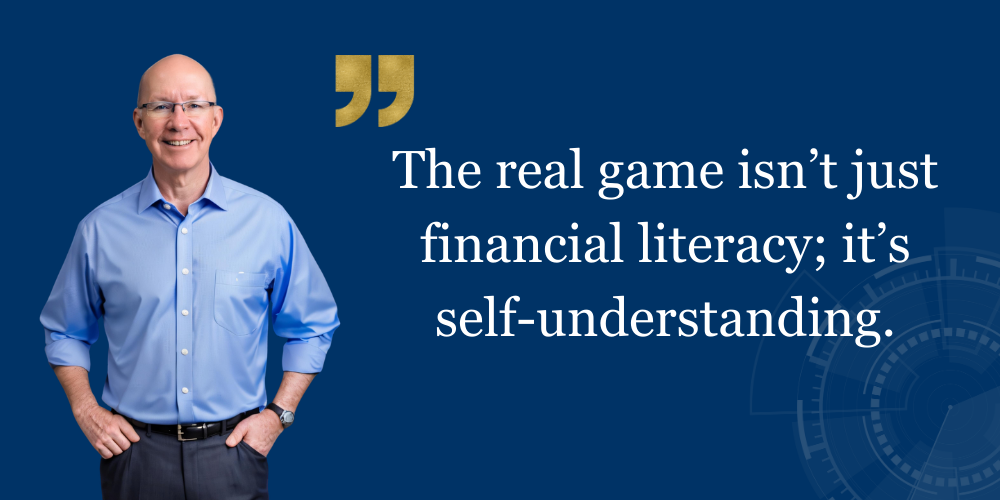
“The real game isn’t just financial literacy; it’s self-understanding—because you can’t build a healthy relationship with money until you build a healthy relationship with yourself.”
By utilizing psychometric tools, the complex interplay between logic, emotion, and predictable human behaviors can be mapped and understood, uniquely for each person, to achieve better outcomes.
Download The Behavioral Economics Guide
Behavioral Economics Today Podcast
Share Your Behavioral Profile
There is a very clear rule when utilizing behavioral profiles. As a leader, you must share yours first, and the person being assessed must see their own results. Trust and understanding only come when there is a level playing field.
“If you’re not willing to share your profile first, don’t deploy profiles at all.”
To create a deliberate culture change, there can’t be any secret psychometrics, information asymmetry, or perceived manipulation. You have to lead with compassion and authentically confront your own strengths and struggles to build lasting relationships.
Multiply Impact With Behavioral Technology
When you use behavioral data alongside demographic and transactional data, you can improve leadership decisions, sales/marketing, and client engagement. You essentially multiply the impact of everything you do.
We understand, however, that traditional surveys aren’t always practical at scale. The game-changer is Digital Scan, our groundbreaking technology that can construct a behavioral profile without the person completing a questionnaire. It is only marginally less accurate and massively scalable.
“The AI-driven Digital Scan removes friction and scales profiling to unlock precision matching for everyone.”
Digital scanning lets leaders get usable insights faster. This simplifies organization-wide heat mapping. It can be used to build more effective teams, match advisors with clients and products, create communication keys that guide conversations, and much more.
Build a More Profitable Future
What drives people-performance is a framework to treat each person uniquely. You need to understand how they prefer to receive information, make decisions, and respond under stress. Then, you have the modern-world tools to propel your business into a more profitable future…and change lives in the process. People will be happier and healthier, and your business will reap the rewards.
Book a Call with one of our experts to see how our psychometric tools can change or amplify the trajectory of your business!

 Leon Morales
 Hugh Massie : March 16, 2021